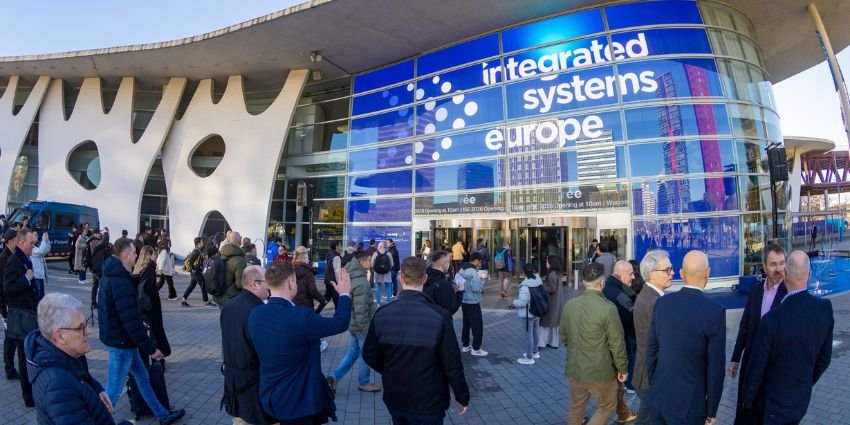
If you walked ISE’s floor this year you’d have seen the usual spectacle: wall-sized displays, immersive audio demos, and enough LED lighting to power a small city.
But sit down with the people deploying this technology—the integrators managing global rollouts, the enterprise IT teams supporting hybrid work, the education leaders trying to standardise hundreds of classrooms—and you hear something different.
They’re not asking for more innovation. They’re asking for less complexity.
The questions at ISE 2026 were variations on the same challenges: How do we achieve consistency across hundreds or thousands of rooms? How do we add AI capabilities without creating security problems we can’t manage? And how do we make decisions today that still make sense in five years?
UC Today was on the ground in Barcelona to find out the answers.
Platform Strategies Replace Product-by-Product Decisions
QSC President Jatan Shah described AV moving from product-by-product decisions toward platform strategies that cover entire environments. His framework starts with applications—audio, video, control—but places them within spaces like meeting rooms, which collectively form places: workplaces, campuses, venues.
Shah described moving “beyond specific use cases” toward using data and sensors to create “insights that actually make… outcomes that are meaningful for the workplaces that we are focusing on.”
That thinking appeared repeatedly across the show floor. Customers want fewer silos, fewer one-off room builds, and a unified management layer that scales.
The language has shifted from “integrations” to full-stack positioning. For buyers, choosing a platform is now an operational decision, where supportability, security model, and lifecycle management matter as much as specifications.
Watch: UC Today’s ISE 2026 interviews (LinkedIn)
If you want the unfiltered booth-floor version of the themes in this round-up, these short clips are the fastest way to catch up.
- QSC at ISE 2026: Platform strategies replacing product-by-product decisions — watch on LinkedIn
- Dell at ISE 2026 (clip 1): What’s changing in enterprise AV/IT buying — watch on LinkedIn
- Connected Classroom: Why “learning everywhere” is reshaping room design — watch on LinkedIn
- Managed services / human connection: What buyers are really outsourcing — watch on LinkedIn
- Public safety: AV and operational readiness in high-stakes environments — watch on LinkedIn
- Dell at ISE 2026 (clip 2): Infrastructure priorities driving refresh cycles — watch on LinkedIn
- Google Meet: Interoperability with Microsoft Teams (and what it signals) — watch on LinkedIn
Interoperability Becomes Infrastructure
Google Meet’s interoperability with Microsoft Teams launched during ISE week. Google Meet Product Lead Quentin Esterhuizen confirmed:
“One [announcement] is our final interoperability with Teams. So that’s been a long time coming.”
The move acknowledges what enterprise IT teams already know: you can’t enforce platform uniformity across suppliers, partners, and internal teams. Mixed estates are standard operating reality. Cross-platform joining needs to work without friction, especially in customer-facing meetings and multi-tenant buildings where you can’t control what platform the other party uses.
For vendors, interoperability is moving from a competitive differentiator to a baseline requirement. Organisations running multiple collaboration platforms—which is most large enterprises—will increasingly treat seamless cross-platform joining as non-negotiable in procurement evaluations.
AI Shifts to Agentic Models, and Governance Gets Urgent
AI was everywhere at ISE 2026, but the conversation has matured. Not so much a demonstration of generative features, more scrutiny about what problems AI actually solves and how organisations govern systems that can act autonomously.
Keynote speaker Sol Rashidi highlighted the move from applied AI through generative AI’s explosion to 2026’s emerging focus on agentic AI—systems that take action, not just generate content. She said:
“Agentic AI is a different beast. Agents can take action.”
When AI systems can execute tasks and make decisions autonomously, policy documents aren’t enough. Organisations need automated governance and monitoring. Rashidi’s advice: “Now outsource your tasks, not your critical thinking, critical thinking and your ability to think independently, think deeply, think autonomously, and your ability to discern, so extracting signal from noise are going to be the two biggest attributes you can maintain.”
The security implications came up repeatedly. Promethean Chief Product Officer Lance Solomon was blunt when asked about primary challenges in 2026:
“I think the biggest is security, quite frankly.”
For buyers, this means treating AI features as part of risk assessment, with questions about data handling, update schedules, and how governance operates when systems act autonomously.
Simplicity and Consistency: The Large Room Problem
One of the most concrete themes at ISE 2026 was where deployment challenges are moving: to larger, more complex rooms. Logitech’s Nathan Coutinho identified the shift: “I think simplicity, consistency, and this wasn’t an issue a couple years ago. It’s more of an issue now, because there’s 1000s of conference rooms.”
Coutinho and colleague Neil Fluester argued that huddle and medium rooms are largely solved problems. The challenge now is larger rooms: featuring higher stakes, more complex setups, and more frequent experience failures. “I think the show this year, there’s two parts,” Fluester said. “It’s iterative and innovation.”
The requirement isn’t better cameras or more microphones. It’s consistency: join experiences that work every time, rooms that don’t need local expertise or instruction cards. Coutinho put it plainly:
“You don’t want to be a human being walking into a massive conference room and, oh, look, there’s 15 cameras. This looks like a science experiment, right?”
For organisations deploying hundreds or thousands of rooms, the priority is repeatability and manageability over showcase specifications. Standardisation and operational tooling matter more than novelty, especially for global rollouts where consistency determines whether the deployment succeeds or generates endless support tickets.
Education: Production Workflows and Security Pressures
Education technology at ISE 2026 centred on two operational shifts. First, higher education content cycles are compressing. AVIXA’s Pam Taggart described institutions capturing sessions, generating transcripts and summaries, then redistributing content in multiple formats—quickly. Classrooms and lecture halls are becoming production environments where workflow matters as much as hardware.
Second, accessibility is moving from accommodations workflows to designed-in approaches. Johns Hopkins University’s Erin Maher Moran emphasised making accessibility purposeful and less conspicuous, requiring collaboration across networking, facilities, infrastructure, and AV/IT teams. She stressed standardisation for scale but warned against standards too rigid to evolve with teaching methods. She explained:
“You can’t put different things in every single room, and then expect that we’re going to be able to support that easily. So it really is about trying to stick to a standard, but not so rigid that it can’t evolve and change with the needs of of the faculty and classes.”
What Changed at ISE 2026
The shift at this year’s show was subtle but significant. The buyers getting airtime—integrators, enterprise IT teams, and education leaders—are asking different questions. Not “what’s the latest feature?” but “how does this scale?”
Three developments look likely before ISE 2027. Interoperability will become a standard procurement requirement—vendors without credible cross-platform stories will face harder questions. Large-room standardisation will accelerate as vendors expand into complex spaces where adoption decisions get made. And AI governance will move from theory to implementation, with vendors building governance capabilities into platforms rather than treating it as separate.
ISE 2026 had its share of marketing language, but beyond the announcements, the conversations were about operational capacity, security posture, and whether solutions will still make sense in five years. For vendors, that means proving repeatability, not just innovation. For buyers, the questions that matter aren’t about specifications. They’re about what happens after the installation team leaves.
Read more from ISE 2026:
security, and platform thinking—in plain terms for IT, AV, and UC decision makers.
What were the biggest themes at ISE 2026?
The biggest themes at ISE 2026 were interoperability, “invisible” AI that reduces friction, the push
into large and extra-large rooms, security and longevity, platform/ecosystem thinking, and education
workflows (capture + accessibility + collaboration).Is AI still the headline story—or is the hype cooling?
AI is still a headline topic, but the conversation has matured. Buyers care less about AI as a label
and more about what problem it solves, whether it is secure, and whether it reduces user friction and
support burden at scale.What does “agentic AI” mean, and why should AV/UC teams care?
Agentic AI means AI systems that can take actions, not just generate content. AV/UC teams care because
action introduces governance requirements: permissions, guardrails, auditability, and risk management.Why is “single pane of glass” being talked about so much?
“Single pane of glass” matters because organisations now manage hundreds or thousands of rooms and
endpoints. Teams want one way to monitor, manage, update, and troubleshoot environments without having
to scale headcount at the same pace as deployments.What’s driving the push toward “platforms” and “ecosystems”?
Complexity is expensive. Customers want fewer integration headaches, clearer accountability, repeatable
deployments, and more predictable operations—so platform approaches and broader ecosystems are gaining
momentum over one-off room builds.Why are large and extra-large rooms suddenly the “next battleground”?
Small and medium rooms are relatively mature. The hardest challenges—multi-camera, acoustics, room
complexity, and consistent experience—show up in large spaces, which also host executive meetings and
high-stakes events that influence wider standardisation decisions.What’s changed in meeting-room expectations since the pandemic?
Users now have a clearer sense of what “good” looks and sounds like. Tolerance for poor audio, clunky
joining, confusing controls, or inconsistent room behaviour is much lower than it was pre-pandemic.What does “invisible AI experience” mean in practice?
“Invisible AI” means the technology just works: joining is consistent, audio is clean, camera framing
behaves predictably, source switching is painless, and support tickets go down. AI becomes a background
enhancer rather than a gimmick.Is interoperability actually improving, or is it still mostly talk?
Interoperability is improving. A key signal at ISE 2026 was Google Meet announcing interoperability
with Microsoft Teams, reflecting real demand for cross-platform joining in mixed environments.Why did cybersecurity come up so often at ISE 2026?
Cybersecurity came up frequently because connected AV endpoints and cloud services expand the attack
surface. Organisations are increasingly upgrading systems for security requirements—even when installs
are only a few years old.